

“Do I need Botox or filler?” is one of the questions I am asked most frequently in clinic.
Often, the honest answer is not immediately obvious.
You may feel that your face looks more tired, less defined or simply different from a few years ago—but that does not necessarily tell us which treatment will help. Botox and dermal fillers work in completely different ways, and choosing between them should begin with understanding why your face has changed.
At Westfield Aesthetics in Edgbaston, my starting point is never, “Where shall we inject?” It is:
What is creating the change that bothers you—and what is the most appropriate, proportionate way to address it?
Sometimes the answer is Botox. Sometimes it is filler. Occasionally, a carefully planned combination works best. And sometimes I will advise that neither is necessary.
What is the difference between Botox and dermal fillers?
The simplest distinction is this:
- Botox softens lines caused by repeated muscle movement.
- Dermal filler replaces carefully selected areas of lost volume or structural support.
They are not interchangeable treatments.
Botox cannot restore lost cheek volume, while filler does not stop the muscles that create frown lines. A successful treatment plan depends on identifying whether your concern is primarily caused by muscle movement, volume loss, changes in facial support—or a combination of these.
What does Botox treat?
“Botox” is commonly used as a general name for botulinum toxin or anti-wrinkle injections, although Botox itself is a particular brand.
Botulinum toxin temporarily reduces the activity of selected facial muscles. It is most useful for dynamic lines: lines that appear or deepen when you frown, smile or raise your eyebrows.
These commonly include:
- Frown lines between the eyebrows
- Crow’s feet around the eyes
- Horizontal forehead lines
- Other concerns caused by excessive or unbalanced muscle activity
The aim should not be to remove every expression or make the face look unnaturally still. Thoughtful treatment can soften strong movement while preserving the expressions that make you look like yourself.
Botox may be appropriate if:
- Your lines are most noticeable when your face moves
- You look cross, tense or worried when you do not feel that way
- Strong muscle movement is contributing to a particular concern
- You want to soften lines without adding volume to the face
Botox is a prescription-only medicine in the UK, so your medical history, facial anatomy and suitability for treatment should be properly assessed before it is prescribed.
What do dermal fillers treat?
Dermal fillers are injectable gels, most commonly made from hyaluronic acid. Rather than reducing muscle movement, they are used to replace volume, improve support or refine facial proportions.
As we age, facial change is not simply a matter of developing wrinkles. There are gradual changes in the skin, fat compartments, ligaments and underlying bone. This can lead to flatter cheeks, deeper folds, reduced definition and a more tired or drawn appearance.
Carefully placed filler may be used to:
- Restore selected areas of cheek or mid-face volume
- Improve facial balance and proportion
- Support areas affected by age-related volume loss
- Soften certain folds or shadows
- Add subtle definition to the lips, chin or jawline
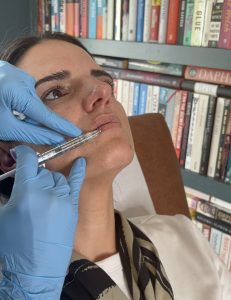
The important word is selected. Good filler treatment is not about making every area fuller. In some faces, adding volume in the wrong place can make the face appear heavier or less natural. The skill lies in deciding whether volume is genuinely missing, where support would be helpful and how little product is needed to create a meaningful improvement.
Dermal filler may be appropriate if:
- Your face has become flatter, more hollow or less defined
- Your cheeks have lost some of their previous shape
- Shadows and folds are being caused by reduced facial support
- You want to restore rather than dramatically alter your natural proportions
How can I tell whether a line needs Botox or filler?
One useful clue is whether the line is caused mainly by movement.
If a line appears when you frown or smile and becomes much less visible when your face relaxes, Botox may be the more relevant treatment.
If the concern is present at rest and relates to hollowing, flattening or loss of support, filler may be more appropriate.
However, not every line should be “filled”, and not every wrinkle should be treated with Botox. Skin quality, sun damage and natural facial anatomy also affect how the face ages. Treatments such as skincare, chemical peels, microneedling, polynucleotides or other skin-focused approaches may sometimes be more useful than either Botox or filler.
This is why an in-person assessment matters.
What if I have both lines and volume loss?
Many patients—particularly in their forties, fifties and beyond—have a combination of changes.
For example, you may have:
- Frown lines caused by repeated muscle movement
- Reduced cheek support contributing to a tired appearance
- Changes in skin texture that neither Botox nor filler will fully correct
In that situation, a combination treatment may produce a more balanced result than repeatedly treating one isolated area.
That does not mean having large quantities of several products at once. It may mean treating one priority first, reviewing the result and then deciding whether anything else is genuinely needed.
I often prefer a gradual approach. It allows us to assess how your face responds and helps avoid the overfilled appearance many patients understandably fear.
Which treatment looks more natural?
Either treatment can look natural when it is appropriately chosen and carefully performed. Equally, either can look unnatural when it is overused or poorly planned.
A natural result depends on:
- Correct assessment of the underlying concern
- Detailed knowledge of facial anatomy
- Appropriate product selection and placement
- Conservative dosing
- Respect for your individual features
- Knowing when not to treat
The goal is not to create a completely smooth, expressionless or newly constructed face. It is to help you look fresher and more rested while retaining the features, movement and character that make you recognisably you.
Ideally, other people should notice that you look well—not immediately identify what treatment you have had.

Is Botox safer than filler?
Botox and dermal fillers have different risk profiles, so it is not helpful to describe one as universally safer than the other.
Some possible effects of anti-wrinkle injections include bruising, headache, unwanted weakening of a nearby muscle and, very rarely, more serious complications.
Dermal fillers may cause swelling, tenderness, bruising, lumps or infection or rare side effects caused by occlusion of vessels.
These risks are why injectable treatments should never be treated as casual beauty procedures. Your practitioner should understand facial anatomy, use reputable products, recognise complications promptly and have a clear plan for managing them.
Can Botox and fillers be used together?
Yes. Because they address different causes of facial ageing, Botox and filler can complement one another when both are genuinely indicated.
They may be performed during the same treatment plan, although they do not always need to be done during the same appointment.
For a new patient, it can be helpful to prioritise the concern that will make the greatest difference, allow the result to settle and then reassess. More treatment is not automatically better treatment.
Which treatment should I have first?
There is no universal order.
The decision depends on your facial anatomy, your priorities, previous treatments, medical history, timescale and budget.
For one patient, softening a strong frown may be enough to make her look more relaxed. For another, restoring a small amount of lost cheek support may make a greater difference. Someone else may benefit more from improving skin quality without having Botox or filler at all.
The correct question is not:
“Which treatment is better?”
It is:
“Which treatment—if any—best addresses the reason I look different?”
A doctor-led approach to Botox and fillers in Birmingham
After more than 30 years as a doctor, I believe cosmetic treatment should begin with listening, examination and honest advice.
At your consultation at Westfield Aesthetics, we will discuss what has changed, what bothers you and what you would like to achieve. I will assess your face both at rest and in movement, explain the options that are relevant to you and discuss their limitations and risks.
You will not be encouraged to have treatment that I do not believe will benefit you.
For some patients, Botox is the right answer. For others, carefully placed dermal filler is more appropriate. Sometimes a gradual combination gives the most harmonious result—and sometimes the best advice is to leave well alone.
The aim is always the same: a subtle, balanced result that still looks like you.
Frequently asked questions
Does Botox add volume to the face?
No. Botox reduces the activity of selected muscles; it does not replace lost facial volume. Concerns caused by flattening, hollowing or reduced structural support may require a different approach.
Can dermal filler remove forehead lines?
Filler is not usually the first-line treatment for forehead lines caused by repeated expression. Anti-wrinkle injections or treatments aimed at skin quality may be more appropriate, depending on the individual concern.
Which lasts longer: Botox or dermal Filler?
Botulinum toxin treatment is temporary and generally requires maintenance if you wish to preserve the effect. The longevity of filler varies considerably according to the product, treatment area, quantity used and individual metabolism. Longer-lasting does not necessarily mean more appropriate.
Will I need more filler as I get older?
Not necessarily. Treatment should be reviewed according to how your face changes and whether the existing filler is still present. Automatically adding more product at regular intervals can lead to an unnatural or heavy result.
Can I have a consultation without committing to treatment?
Yes. A consultation is an opportunity to understand your face and your options. You do not need to decide on treatment during the appointment.
Book a consultation
If you are considering Botox or dermal fillers in Birmingham but are unsure which treatment would be right for you, a consultation is the safest place to begin.
At Westfield Aesthetics in Edgbaston, you will receive a detailed, doctor-led assessment and an honest treatment plan based on your face—not a standard package.